NATUR - LOCHKARTEN
Nature
is wild, unpredictable and ultimately beautiful. A punchcard is a stiff piece
of paper that contains digital information represented by the presence or
absence of holes in predetermined positions. It was an early system used to
control textile looms and mechanical computers for input, and processing, it is
a system to aid reproducing the same affect again and again thus mimicking what
takes place naturally in the world around us such as when a spider weaves its
web.
NATURES
PUNCHCARD
SPEEDING
UP THE WORK OF NATURE
I utilize the
Sculpture Studio as a laboratory to examine how things exist: I am exploring the
‘nature’ of various materials in a union of concept and process. My
investigations manifest themselves through heat ‘n’ treat practices such as
molding, melting, casting, forging, welding and fabricating. Metal is my ‘prima materia’, and I regard it as a living
material, it breathes, oxidizes, and grows, emerging from the furnace, the
forge and the mould … raw and elemental as it was originally raised from the depths
of the earth.
PRIMA MATERIA
The
metal I utilized to make ‘Natur-Lochkarten’ is reclaimed scrap steel from a
local scrap yard in Salem, Germany which had been used and most probably
discarded by the building industry, some of it was from a demolition site as it
was almost mangled beyond recognition. Originally the new steel had been shaped
into standard stock sizes such as I Beam, Square, Round, Solid, Angeline,
Rebar, Threaded Rod, and Pipe: these are manufactured in large industrial steel
mills, using intense heat they are taken through a journey, once molten, stretched,
shaped, twisted and bundled they are cooled and stacked into the many different
but standard lengths and thicknesses. Much of this steel provides the
foundation and structure of our built environment as we experience it today
such as roads, buildings and bridges.
INDUSTRY
Steel
is processed Iron, Iron is a natural material found in the form of Iron Ore
buried deep within the earth. The ore is basically rock with veins of iron, it
is mined and then in the belly heat of a furnace at 2400 F the rock begins to
bleed out the liquid iron which will produce ingots of pig iron. The pig iron
ingots are melted down again and used to make Steel for constructing and
welding as well as Grey Iron for melting and casting. As well as pig iron,
recycled scrap iron is also used.
Using
the scaled down industrial process of heat forging with a power hammer the
reclaimed steel from the Salem scrap yard was yet again transformed as I worked
it with the element of fire one more time.
OUR
GREATEST ENGINEER
Taking
inspiration from the reoccurring structures and forms observed in nature : I
designed modules in the form of a six spoked wheel, creating a hexagon : with my
parameters set each module could be made in the same manner to the next similar
to the concept of the punchcard system.
Through the union of concept and process I began with the random
selection of steel stock for each spoke, unique hexagons resulted much like the
patterns of a snowflake.
FORGING AND CASTING

I
measured and cut with the best precision possible each section of steel into
the desired length. At this juncture all of the spokes started out the same
length. The end of each spoke was heated in the forge to temperatures between 800
to 1200 degrees Fahrenheit, once ‘cherry red’ the spoke was removed and put
under the power hammer in anticipation of being compacted and flattened. The
power hammer is a mechanical forging hammer that uses a non-muscular source of
power to raise the hammer ready for striking; in this case the power hammer
speed is controlled by using a foot pedal. Once the hot steel is removed from
the forge and placed under the hammer I control the flattening and stretching of
the spoke end but there is an element of nature at play. Fluctuations in the temperature of the forge,
variances in the thickness of the metal and the speed of my actions as I
twisted and pulled the length of steel in conjunction with the hammering action
of the machinery resulted in eccentricities, of which I anticipated and
intentionally manipulated.
Through
this heat ‘n’ treat process the industrial steel stock sections began to revert
back to their original state of belonging to the earth, the recognizable shape
of the standard stock IBeams and Rebar started to disappear revealing evidence
of the fires that formed it.
FRAGMENTATION AND CONNECTEDNESS
With
the hexagon formation as the focal point of the modular system, I pinned and
hinged the many parts together with a combination of heat forged rivets and ratcheted
machine bolts. This accumulative structure is now a semblance of the whole. Reminiscent of the links connecting a
community together: it is a convergence of art and engineering; it can act as a
catalyst for ideas, a structure for a skin: a space for relaxation, education
or entertainment. It is a place for the mind and the body, it is a hearth.
The
work articulates a value towards natural phenomena and a fascination for Iron’s
historical virtue as the plastic of the Industrial Revolution. Investigating
the ‘plasticity’ of Iron, the twisted industrial forms in ‘Natur-Lochkarten’ alludes
to architectural wrought iron as well as the geodesic dome but rather my endeavor
here is to capture our imagination in the environment in which we exist.
Coral Lambert
THE
SCULPTOR
International
Sculptor Coral Penelope Lambert studied at Central School of Art, London, Canterbury
College of Art, Kent and received her MFA in Sculpture from Manchester in 1990.
Specializing in cast metal sculpture as an International Research Fellow Artist
at the University of Minnesota from 95 -98. She is currently Head Professor of
Sculpture and Director of the National Casting Centre Foundry at Alfred
University, New York, USA.
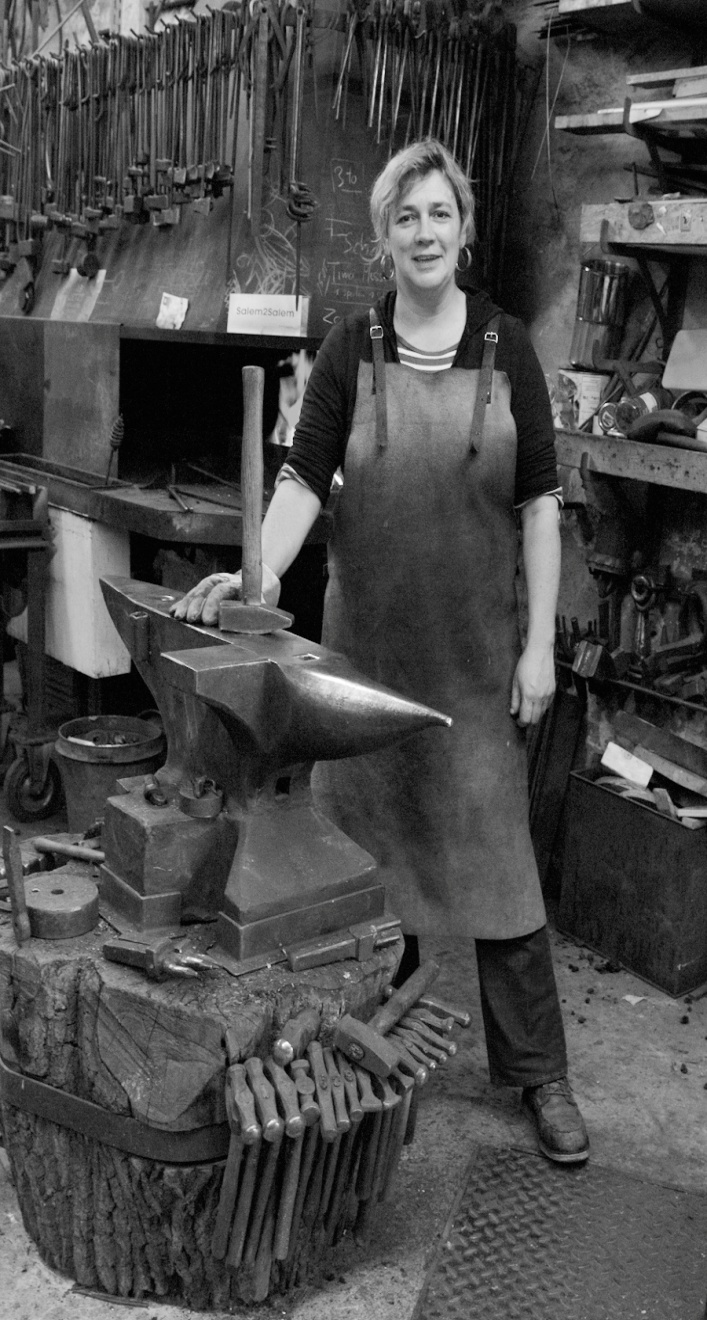
Portrait photo by Ronnie Farley
As
a recent recipient of the Gottlieb Foundation Award and The Joan Mitchell Grant
I am recognized for working in cast iron as well as large scale outdoor pieces,
exhibitions include: ‘The Avant Garden’ at The Barbican Center, London,
Franconia Sculpture Park, MN, ‘Convergence’ in Providence, ‘Grounds For
Sculpture’, NJ, ‘Pier Walk’, Chicago, ‘Atmosferric’ Salem Art Works, NY,
Pirrkala in Finland, Huian China, The National Metals Museum, Memphis, ‘Nature
Rules’, Governors Island, NY and ‘IronStone’ at Kidwelly Castle, Wales.
SALEM
TO SALEM
The
life size working model of ‘Natur-Lochkarten’ was produced in residence at Salem
Castle Blacksmiths Forge during the Salem 2 Salem Symposium 2010. A maquette, video and stills will remain at the Castle with the Sculpture.